HEALING YOU CAN’T GET WRONG.
Trauma therapy for those who are queer, neurodivergent, or simply human.

A NOTE FOR YOU
You are not too much.
No matter what anyone has said or how anyone has treated you:
YOU MATTER.
Your needs matter.
Your feelings matter.
Your experiences matter.
You might be exhausted by the enormity of what you’re carrying
or
Frustrated that no matter how much you’ve tried, nothing has helped.
Whether it’s the “proper” things everyone has told you to try or things that cause you shame.
No matter what:
You’re not broken.
You adapted.
And
You’re still here.
The fact you’re still here says something about the part of you that wants to believe you matter.
There is another way.
My approach starts by believing you matter, even when you can’t yet.
SUPPORT LOOKS DIFFERENT FOR DIFFERENT PEOPLE.
Some folks come to therapy feeling overwhelmed and unsure where to start.
Others have done years of work already and still feel like something is missing.
My role is not to push you towards insight or change when everything feels so activated.
It’s to help you build an internal sense of safety and steadiness so that the deeper work feels doable.
We don’t plow through your hesitancy, your activation, or your shutdown.
We get curious about what they are telling us.
Your reactions, coping strategies, and behaviors developed for a reason.
You are not bad because your thoughts, feelings, and behaviors don’t always align with your values.
They’re simply information that helps us better understand you and your needs.
Part of the work will be understanding patterns, but we also focus on what helps you function, rest, connect, and respond in ways that align with your values.
Therapist by training.
Human by birth.
Weird by default, and good with that.
HI, I’M DEVAN KENNEDY (THEY/THEM)
I understand that healing can feel like swimming through a stormy ocean and getting to the other side seems insurmountable.
I do this work because I know firsthand change can happen.
It’s hard, grueling work.
But I’m so very glad I did it.
Often we think change happens in big, dramatic ways.
The truth is, it’s small shifts that add up over time.
With trauma work, it can feel like it’s no big deal to manage an emotion, or get out of bed, or tell someone what you need.
But it’s those small shifts that get you across that ocean.

You don’t have to know what to call what’s happening to you to reach out for therapy.
Some people come in knowing all the therapy lingo.
Others just need someone to hear what the hell they’ve been dealing with.
Whatever has you googling:
WE’LL EXPLORE IT TOGETHER
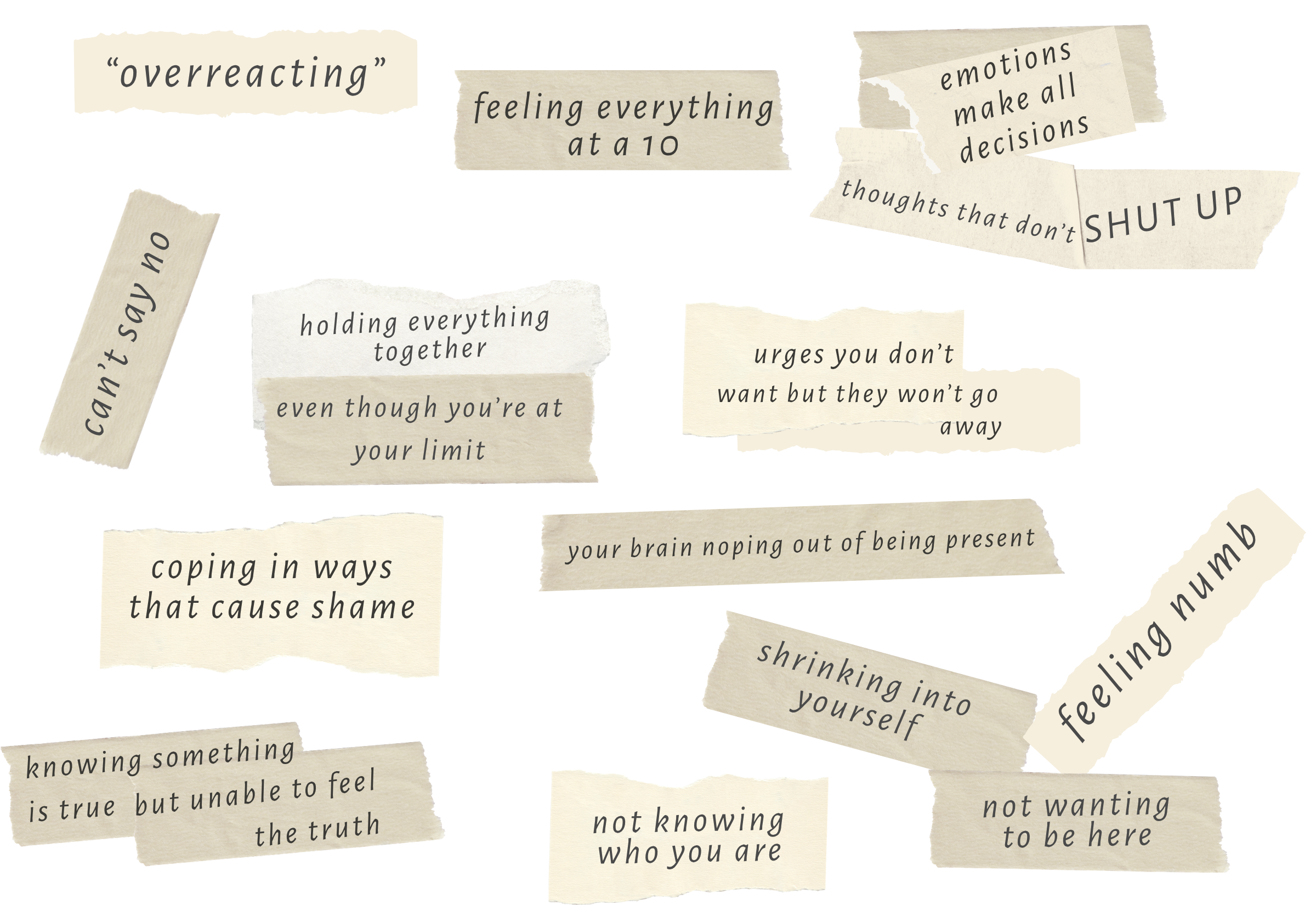
Common struggles may look like . . .
The torn paper scraps read: “overreacting”; feeling everything at a 10; emotions make all decisions; thoughts that don’t shut up; can’t say no; holding everything together even though you’re at your limit; urges you don’t want but they won’t go away; coping in ways that cause shame; your brain noping out of being present; shrinking into yourself; feeling numb; knowing something is true but unable to feel the truth; not knowing who you are; and not wanting to be here.
Maybe you’ve spent a lot of your life learning there is a right way to be.

be like everyone else
go with the flow
don’t be weird
be small and quiet
be man enough
be feminine enough
think inside the box
don’t question
color inside the lines
be obedient
don’t make waves
You’ve spent enough time trying to fit the mold. Therapy doesn’t have to be a place where you have to perform.
I want your questions, your pushback.
What everyone else calls your resistance or being too much is crucial data to help you and me adapt the approach for you, your needs, and how your brain works.
Healing isn’t a straight path so neither should the therapy approach be. The work may include a specific type of therapy or a mix and match. We might start in one direction only to learn we need something else. This is healing you can’t get wrong.